


 800-346-7995
Can Drivable Grass® be mowed after it’s installed?
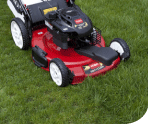 After installation care is similar to your regular lawn care. Water, fertilize and mow as you would the other lawn areas of your landscape. When the Drivable Grass® mats are properly infilled, the wheels of the lawn mower will ride on top of the surface while the grass is cut 1-3 inches above.
See how easy it is to mow Drivable Grass®
How does Drivable Grass® perform in cold weather climates?
Drivable Grass® can move with frost heave in a freeze thaw cycle with no cracking. The product’s interconnecting grid is made from an engineered polymer that remains flexible even in low temperature conditions. Because of its unique shape, and that it is manufactured using air entrained concrete for cold weather climates, cracking of the individual mat pads should not be a concern.
When installing Drivable Grass®, do not use frozen materials or materials mixed or coated with ice or frost. Do not build on frozen, wet, or muddy subgrade.
Can you snow plow Drivable Grass®?
When Drivable Grass® is properly installed, shoveling or snow plowing should not be an issue. Snow plow operators should be educated as to the type of surface they are plowing over prior to beginning snow removal. Teflon runners placed under the snow plow blade are highly recommended. The snow plow operator should be advised to keep the blade up a bit. A 2” to 3” layer of snow left on the Drivable Grass® mats after plowing will rapidly melt, even in cold conditions, due to earth temperature warmth emitting through the product voids and/or solar radiation. Melting snow will infiltrate and will not result in icy conditions on the mat surface in the event of a refreeze.
For sites that will require the use of heavy-duty snowplowing machinery, install concrete curbs and/or strips as a level guide for the snow plow blade prior to installation of Drivable Grass® paving mats. Drivable Grass® should be depressed ¼” below the top of the curb/strip to protect the product from the snow plow blade.
Can the Drivable Grass® concrete paving system withstand the weight of fire trucks and H-20 loading?
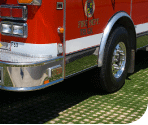 Drivable Grass® is constructed of 8,000 PSI concrete. It was designed and tested for use as emergency vehicle access at large commercial and residential projects and can easily withstand the pressures of heavy traffic loading when the design section is engineered for site specific conditions and the product is properly installed. Proper base preparation is the key to a satisfactory project. See our third party load testing.
How much aggregate base and sand is required for installation?
For professional installations, we recommend the design section be provided by the project soils Engineer. Recommended sub-structure depths will be dependent upon intended usage and soil types.
What is meant by "aggregate base"?
In paving design, an aggregate base is a layer of hard angular material made up of crushed rock and/or sometimes recycled concrete that is placed on native soil to provide a stable “base” for the paving surface and to absorb loads. A typical “base” or “road base” is comprised of materials ranging in size from 1″ – 3/4″ pieces down to small particles like very fine sand. In some areas it is known as “Crusher run”.
What is meant by "sharp sand" in the description of the bedding layer soil mix?
Sharp sand is also known as builder’s sand or washed concrete sand. It meets the specification of ASTM C-33. Sharp sand has the same properties as the aggregate base, sharp angular edges and decreasing smaller particle sizes. The top particle size is rather large, about 1/8 inch in diameter and the smaller end, zero percent passing a #200 sieve. Do not use play sand, mason sand, or sand box sand.
What is the steepest grade where Drivable Grass® should be used?
Drivable Grass® is recommended for slopes as steep as 12% with vegetated infill. Installation of Drivable Grass® for traffic loading on grades steeper than 12% must be evaluated by a qualified engineer or architect.
Can Drivable Grass® be placed on a hillside?
Yes, Drivable Grass® can be placed on a hillside as long as the slope is stable and Drivable Grass® is not acting as a retaining wall. If the intention is to vegetate Drivable Grass® on the hillside (i.e. Hydroseed the installation), a basic biodegradable erosion control blanket can be placed directly underneath Drivable Grass®. If vegetation is not required / desired, a filter fabric should be placed underneath the Drivable Grass®.
What types of grass should I use in the Drivable Grass® concrete paving system?
Talk with your landscape architect, local nursery or landscape supplier for a recommended grass in your area. They will be the best source of local information concerning the best grass variety to grow in your area and withstand the desired traffic levels. Typically, it is a Kentucky Bluegrass/Perennial Rye mix for northern regions and Bermuda, Zoysia, or Bahia hybrids for use in southern climates.
What is meant by "organic material" in the description of the bedding layer soil mix?
By “organic material” we mean finely ground, well screened composted products such as composted manures, mushroom compost or green-waste compost. It is important that the material be finely ground, not the size that would be used for mulching planting beds.
What alternative ground covers can be used in the Drivable Grass® concrete paving system?
Along with normal lawn grass, Drivable Grass® can also be filled with sand, gravel, colored rock, or artificial grass. We recommend an angular stone for stability. In low use traffic areas, you can also lay sod over the product.
How does the Drivable Grass® concrete paving system compare to turf blocks or other concrete pavers?
Drivable Grass® is a flexible concrete mat system. Other concrete turf paving systems are blocks, tiles or cast-in-place concrete. All are rigid and utilize a cellular system for plant growth. Turf is grown in cells or voids within the block and, due to the product’s deep side walls, each cell is an isolated planting area. The deep side walls don’t allow the exchange of moisture between cells so even distribution of moisture is virtually impossible. And, when the concrete heats up during the day, this heat is transferred through the side walls to the planting root zone and causes evaporation and soil compaction. The result is poor plant growth. Being a mat system, Drivable Grass® lays over its root zone, which is continuous beneath the installation area. This allows the system to act like a normal lawn area and balance moisture distribution through capillary action. Additionally, while Drivable Grass® is 60% open at the surface, the underside is almost 90% contained, thus holding moisture in the root zone during the hot parts of the day. And, because the mats are flexible, they conform to designed or natural contours in a smooth flowing manner, where turf blocks or tiles require angle points.
How does the Drivable Grass® concrete paving system compare to plastic grid turf paving?
Among the plastic systems some are roll delivered and others are tiles and still others are expandable. Most offer the ‘flexibility’ of a plastic product when installed but after a while develop a ‘memory’ and become somewhat rigid. This often results in the product popping-up or daylighting under heavy loading. Another negative factor is the potential for ‘cookie-cutting’ into saturated soils. Most plastic systems have virtually no inherent strength relative to vehicular loading and are subject to damage especially from sustained traffic and thus are not suitable for regular drive use. Drivable Grass® is made from 8,000 PSI concrete and is an excellent wearing surface. Its large bottom surface area provides a stable platform for vehicular use. And, the system’s connecting grid remains flexible even in extreme cold.
Is Drivable Grass® easy to install?
Drivable Grass® concrete paving system is a simple to do project. Installation is similar but easier than pavers and is explained in detail in our CSI Masterspec format specification and our step-by-step installation instruction on our website soilretention.com. Installation is more forgiving than pavers since the product comes in a mat instead of small individual pavers that require specialized equipment.
How do I irrigate Drivable Grass®?
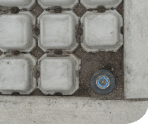 Irrigation can be done by an overspray pattern along the sides of the installation. For large installations where perimeter coverage is not enough, irrigation can be run under the Drivable Grass® with cut or removed muffins allowing for pop-up riser operation. There are also advanced underground drip systems & rotors available, contact your local landscape irrigation supplier for details.
See how easy it is to include an irrigation system with Drivable Grass®: Irrigating Drivable Grass
What type of contractor would install this product?
Any contractor that installs pave stones can easily install this product for you. The ground preparation is similar to pave stones.
How is Drivable Grass® cut to fit in irregular areas?
Drivable Grass® can be cut along the internal grid pattern using a utility knife or cold chisel. For curves and precision applications you can also cut the concrete product with a standard concrete saw blade.
Does the Drivable Grass® concrete paving system need a border or edging?
Generally, Drivable Grass® should always be contained using hard containment such as a concrete header or landscape paver edging. In applications where the direction of travel is straight in/straight out, containment such as embedment in an established lawn or landscape berm may be an acceptable alternative.
How do you delineate parking stalls when using Drivable Grass® in parking lots?
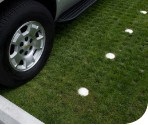 Parking stalls can be delineated by striping the Drivable Grass® mat surface where turf will be kept low. Where higher turf or full turf coverage is desired, delineating parking stalls can be achieved by installing headers between stalls or using standard highway lane markers epoxied to the mats. Refer to our drawings on our website soilretention.com for details.
What size and colors does the Drivable Grass® product come in?
Drivable Grass® concrete paving system is produced in 2’ x 2’ mats allowing for easy installation. Currently, it is available in buff/tan and natural grey nation wide, plus a terra cotta color is available from our California plant only. For large installations feel free to contact us concerning producing the Drivable Grass® mats in custom concrete colors. Drivable Grass® mats can be stained with any standard concrete stain prior to installation.
I hear a lot about permeable paving products, what is the importance of your product being permeable?
Drivable Grass® allows storm water to filter through the product into the subsurface. In drought prone areas this can be very important as it reduces site runoff and helps exfiltrate storm water into the water table. This also allows contaminants (vehicle drippings, car wash chemicals and such), to filter through the aggregates installed below the product so that they do not enter the local drain system and contaminate the local waterways and oceans. In addition, the turf grass system also biodegrades pollutants. Using Drivable Grass® will also reduce the amount of impervious surfaces on a project site and may allow a larger building footprint.o.
What is the importance of your product being flexible?
The flexibility of our product allows it to be used on contour landscape designs, and, therefore is not limited to a flat plane as with concrete or pave stones. Also due to it’s flexibility you will not have an issue with a cracked drive surface like you would with concrete, asphalt or a pavestone.
Can Drivable Grass® concrete paving system qualify as an ADA accessible surface?
Drivable Grass® will qualify as an accessible pathway surface when approved by the local authority and properly installed and maintained with soil or aggregate infill no less than ¼” below the surface of the mat pad. For this application, it is recommended that Drivable Grass® be installed with pads positioned in a diamond pattern in relation to the direction of travel. Drivable Grass® can also be installed with full coverage sodded turf. Turf is considered an accessible surface.
What other benefits does the Drivable Grass® concrete paving system provide?
Drivable Grass® can contribute to achieving LEED® credits in numerous categories. Complete information is available on our web site. The most common benefit is the reduction of Heat Island Effect. Also, by providing a stable, drivable structure to your landscaped areas while retaining the aesthetically appealing green look, there is an expected advantage in “curb appeal” over standard concrete or asphalt surfaces.